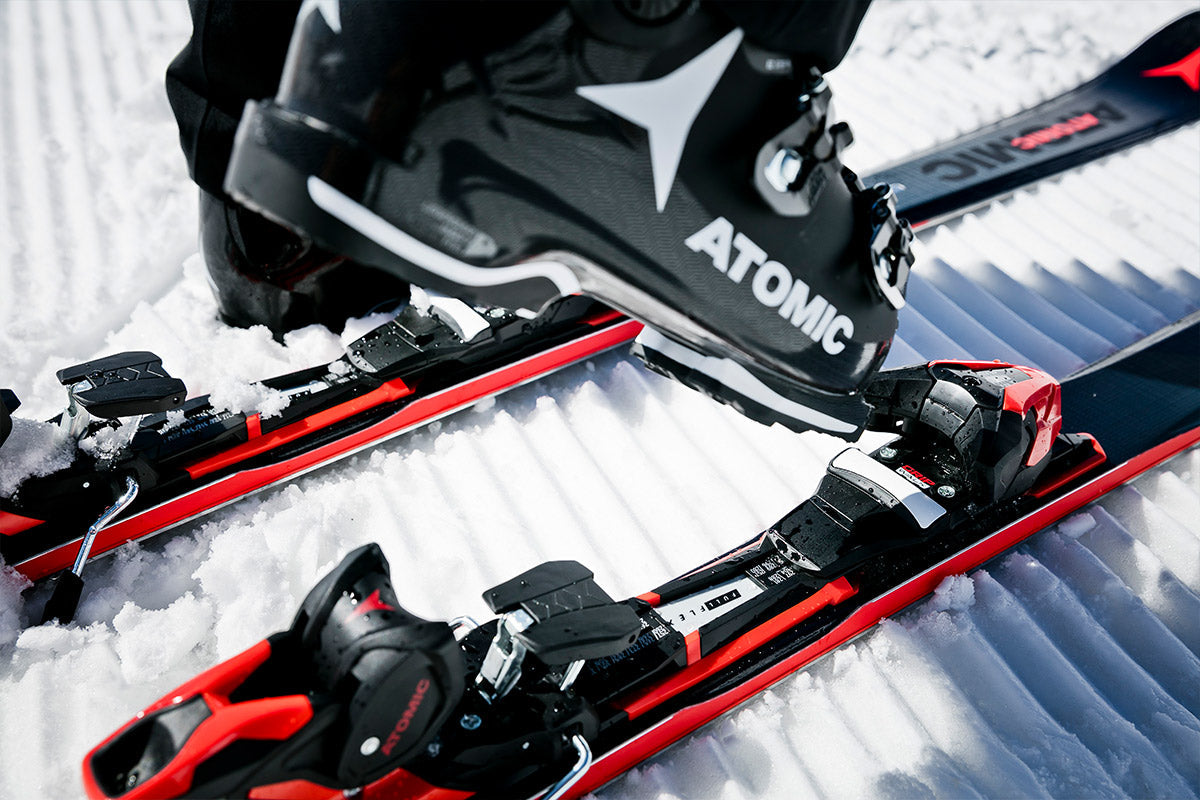
There has been, and still is, a rapid development of skis for great skiing in loose snow. Traditional ski brands such as Fischer, Dynastar, Salomon, Atomic, Head and K2 have all thrown themselves into the development, but the new possibilities have also given way to "new" brands such as Faction, Line and Black Crows. The development has also created new world stars that are now as big as the names in the more traditional alpine disciplines. Most people know who Candide Thovex (Faction), Eric Pollard (Line) and Sean Pettit (K2) are. If nothing else, a lot of people have seen their videos showing the new possibilities that ski development has opened up on YouTube. For example, Candide's video, One of those days 2, has more than 25 million hits!
The rapid development can make choosing skis seem a bit overwhelming. So here's a short guide with some simple guidelines to help you follow the stars into the challenging terrain.
Four factors
Broadly speaking, there are four factors to consider when choosing your off-piste skis; width, stiffness, rocker and length.
Width
Width is really what makes a ski suitable for off-piste. Skis under 90 mm are not suitable for loose snow. Conversely, many people think that the widest skis are harder to ski on. They are not! At least not if you ski in loose snow. Width is what gives lift in the snow. The wider - the more lift - the easier to ski! Where the widest skis fall short is on hard, steep and mogul terrain. The width makes the ski slower from edge to edge and gives less edge grip.
Stiffness
Stiffness has always played a big role in ski selection. The general rule is that the more skilled you are, the stiffer your skis should be, and in principle this also applies to off-piste skis. However, the widest skis tend to be quite soft. This is to give them buoyancy and make them easier to turn in loose snow. As an all-round ski, it can be good to have some stiffness as it provides some safety and edge grip should you be unlucky enough to hit an area with hard snow/ice. If you choose a soft ski, it can be an advantage to increase the length slightly to compensate for the lack of stability.
Rocker
A good rocker can also compensate for both width and stiffness. If you have a good big rocker, the ski doesn't need to be quite as wide and you can also make the ski a little stiffer. Roughly speaking, a 90 mm, very stiff ski without rocker is no good in loose snow and will dive, while a 140 mm soft ski with a huge rocker will lie on top of even the lightest snow. Both are available!
Length
The length of the ski plays a big role when choosing. For off-piste, they must not be shorter than head height! If you are skilled and can push the skis, they should be longer. If the ski is soft, it's a good idea to go a little longer and the same applies if you find one with a good rocker. The bigger the rocker, the longer the ski. Again, for randonee/touring you can compromise a little and choose a slightly shorter ski to save weight, but this will compromise ski length (and in this case directional stability) on the way down.
In other words, the optimal all-round off-piste ski is an approximately 104-115 mm medium stiff ski, with between rocker and 5-10 cm above head height (if you have a normal build). With this as a starting point, you can then adjust the width, stiffness, rocker and length up and down according to your level and skiing style.
More about width selection
Off-piste light skis
Skis between 90 and 100 mm are best suited for a combination of off-piste and piste. These are skis that still have good edge grip and are therefore skiable on the piste. The width allows them to ski in loose snow, but they are perhaps at their best in deep and heavy snow. If you're into Randonee/skitouring, the slightly narrower skis naturally also give you less weight, which is an advantage uphill. If you're a freestyle skier, there are plenty of twintip skis in this width.
Off-piste all-round skis
If you're serious about off-piste and want skis that are suitable for most situations, you should choose skis that are between 100 and 120 mm. Of course, there's not much difference between 99 and 101 mm, but roughly speaking, it fits very well. The closer you get to 120 mm, the better they are off-piste and vice versa. The perfect middle ground is a 110 mm ski
Off-piste-all-in-ski
If you're only going for real powder days in Canada or Japan, skis under 120 mm are probably a bit too small. A few years ago, skis were produced that just got wider and wider, but gradually a natural range has been found where the maximum is around 140 mm. The widest skis are typically twin tip skis, which are made for playing in loose snow. They are designed so you can ski backwards, spin around and make butters in the lightest powder.
To sum it up
In other words, the optimal all-round off-piste ski is an approximately 110 mm medium stiff ski, with between rocker and 5-10 cm above head height (if you have a normal build). With this as a starting point, you can then adjust the width, stiffness, rocker and length up and down according to your level and skiing style.