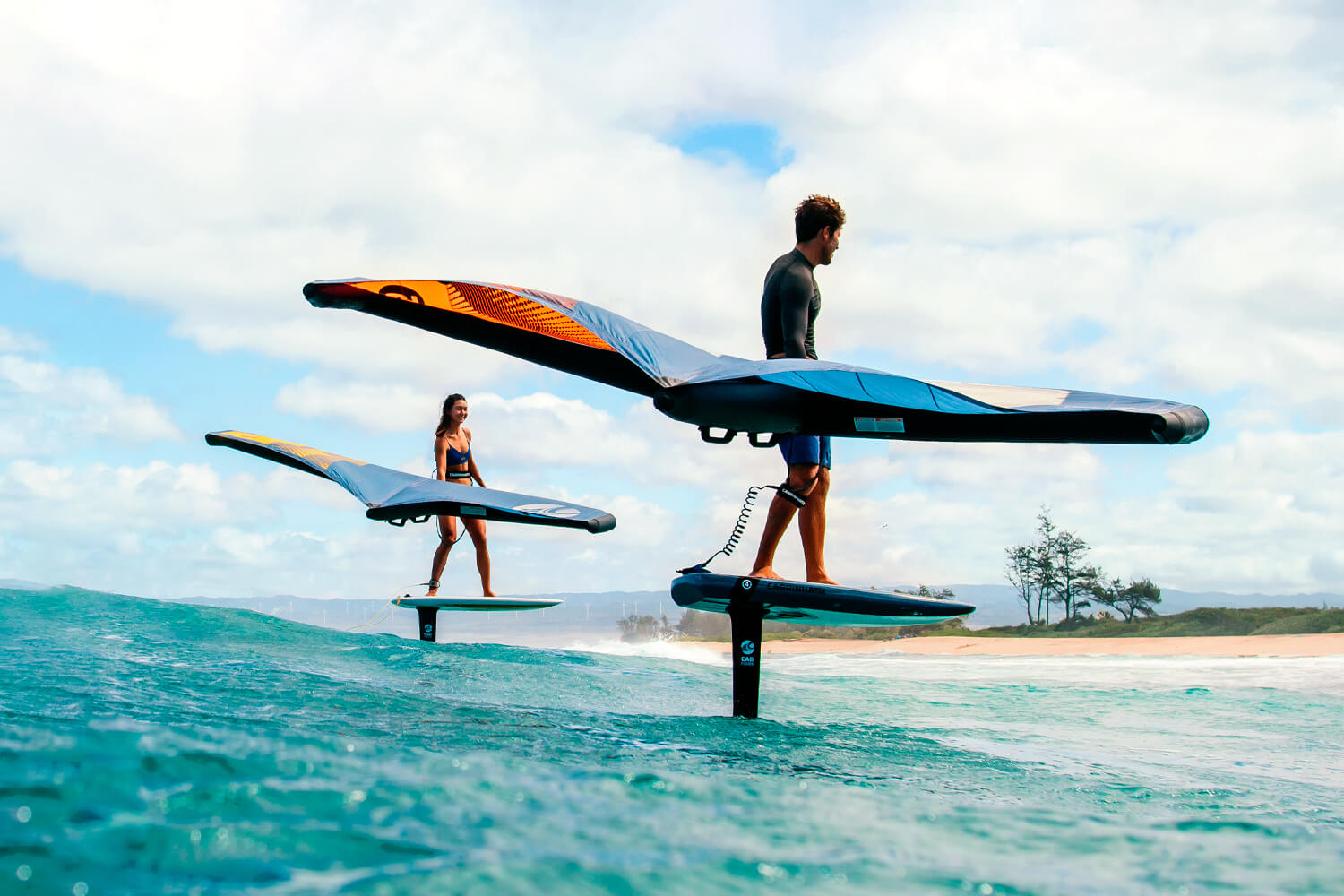
Hydrofoil, also known colloquially as foil, is the long mast with wings mounted under the board that makes you "float" above the water. Foil surfing is a relatively new discipline and has become increasingly popular in kitesurfing, windsurfing, wing-surfing and general surfing in recent years.
Parts and structure of the foil
Frontwing: When we look at a foil frontwing, we look at how much and how fast it lifts, as well as its stability and speed, which is related to whether it is low, medium or high aspect ratio. A low aspect frontwing will be more narrow and deep, whereas a high aspect frontwing will be very wide and low. The advantage of a low aspect frontwing is that it will provide more lift, a quick take-off and more stability. This means it requires less "pumping" to get it going compared to a high aspect frontwing, making it better for beginners. Additionally, with a low aspect foil, you compromise on speed and glide in the water compared to a high aspect frontwing. This can be an advantage for beginners who get a quieter start and if you need to foil a wave, so you don't get ahead of the wave too quickly. When you're a beginner, a larger frontwing can be an advantage to choose to get a faster lift and make it easier to get up on the foil. A large frontwing will be around 1800-2000cm2 for wingfoiling, 1300cm2 for surffoiling, just over 1000cm2 for windfoiling and just under 1000cm2 for kitefoiling. However, what size frontwing you need depends on the purpose, rider weight and level.

A high aspect frontwing is a big advantage when foiling on flat water and you want speed. The wide but low shape of the foil means that it needs to be pumped more before you get a lift, while being less stable and forgiving. However, the high aspect front wing provides long glides per pump, giving you more time on the foil without having to pump too hard. A high aspect offers more aggressive surfing and performance.
Wingtips can be found on some frontwings. Wingtips are where the two ends of the front wing curve down. It provides more stability when foiling and is similar to fins. However, it means that you lose some of the area of the front wing and thus challenges the lift a little.
We have frontwings that are produced in carbon and fiberglass. Carbon is the most common material used to produce foils. Carbon is chosen to achieve optimal stiffness, which counteracts the slack on the mast that occurs when it bends. The stiffness provides better foiling and faster response.
Tail wing:
The tail wing balances the front wing and makes the entire foil more stable. Front and tail wings are often very similar in size and appearance and are often sold as a set. However, choosing a smaller tailwing would give a smaller lift. This means that the surfer has to put more weight on the tail (back end) of the board to balance the front wing. However, a smaller tailwing will make it easier to turn and allow you to pump faster. An experienced foiler can therefore experiment with different sizes of front and tail wing to find the best setup.
Fuselage:
The fuselage is the stick that determines the distance between the front and tail wing. A longer fuselage gives you more speed control, while a shorter fuselage gives faster response and pump.
Mast:
When it comes to the mast, length and stiffness are the main factors. If the mast is longer, it's easier to turn without the board coming into contact with the water. A longer mast makes it easier to get up to speed because you don't need to pump as fast as with a short mast. However, a longer mast also makes the foil more unstable, so it requires more balance. It will also be lower in the water, which will make it harder to get lift as it's further up. With a longer mast, more stiffness is required to hold the surfer's weight without bending and causing slack. Therefore, the longer masts are constructed thicker, which can challenge the aerodynamics a bit. A long mast will be around 100cm and will be most suitable for kitefoiling and windfoiling. A shorter mast will be around 60-75cm and is more suitable for surffoiling and wingfoiling.
If the mast is shorter, however, it provides more stability, makes it easier to get the foil lifted and can also be foiled in shallower water without the foil hitting the bottom. The shorter mast also catches waves more easily and is therefore best for surf foiling and wingfoiling in the waves. A shorter mast is also best for beginners, as it provides the most stability while learning the balance of the foil.
Mounting the foil: When mounting your foil, you have two channels in the board where you can control how far forward or back it sits on the board. You should have your back foot slightly behind the foil on the board so you can control the pumps on the foil better. For the beginner, you would start by placing the foil roughly in the middle. Then you can move the foil further forward if you need lift or move it back if the foil lifts too quickly. If you don't weigh much, it's a good idea to mount the foil further forward on the board.

The different types of foiling
Wing foil:
When wing foiling, you have a relatively short mast to catch the waves and to get a quick lift in the foil. However, you don't use the very short one as you have a slightly larger board in wingfoiling and you want to avoid the board hitting the water in your turns. As a beginner, you have a frontwing area of around 2000cm2 and a mast of about 75cm to help you get started surfing. Of course, this size depends on the weight of the surfer.
It could be Starboard's S-type foil, with their 82cm mast and Starboard's wingboard lite tech board, where the size of the board depends on the weight of the rider. A rule of thumb for wingboard beginners is rider weight + 20 L. For a 95kg rider, the starboard wingboard lite tech 6'3" x 28" at 115L would be ideal.
Kitefoil:
In kitefoiling you already have a lot of power from the kite and thus it helps a lot on lift. Therefore, you use a smaller area of frontwing and tailwing. Because there is so much power from the kite, you can also get a lot of speed, which is why you also use a longer mast for kitefoiling.
A good starter foil set would be the Naish Hover kite 127 4'2" at 127cm together with Naish kite foil with 85cm mast and 960 cm2 frontwing.
Foil surfing:
For surf foil you want to get as much power from the waves as possible and therefore use a shorter mast. In addition, you want to use a low-medium aspect frontwing so you don't get ahead of the wave and get too much speed. The volume of the board depends a lot on weight and experience, but for a beginner it's around 40L. In addition, a foil with a short mast and a frontwing around 1300cm2 would be ideal.
A good beginner set could be NSP's DC surf foil of either 40L or 45L depending on weight together with Naish surf jet foil with a 1250cm2 frontwing and 65cm mast
SUP foiling:
For SUP foil it can be a big help to have some volume in the board below you, so you can stand on the board before the foil has started. Therefore, we would recommend around 25L-40L above body weight, depending on the level of the SUP foil board. A good set here would be NSP's SUP foil with either 116L or 129L (depending on the weight and level of the rider) with an NSP Airwave front wing of 1700cm2. The Airwave foil set has a low aspect ratio and large front wing area, which will make it easier for beginners to get started. For that, an NSP speedster paddle would be a good fit in a size that suits the rider's body weight and level. As a beginner, it can be an advantage to choose a vario paddle so you can adjust the height of the paddle.
Windsurf foil:
For windsurf foil, Starboard's foil freeride starlite board is a good choice, which is available between 125-150 L. Here, the liter of the board must fit well with the weight of the rider. You can add Starboard's GT-R plus 800 foil package to this.