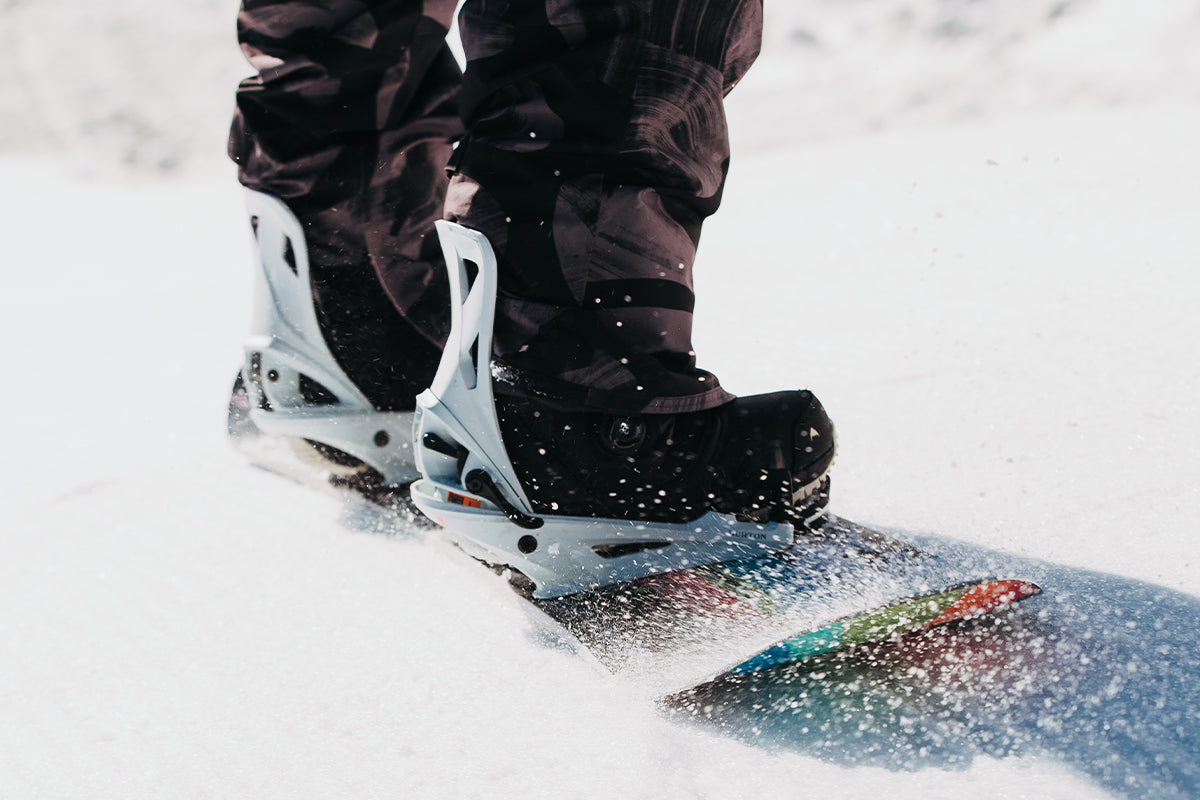
For the less experienced snowboarder, it can be difficult to decide which board best suits your needs; true-twin, camper, pure-pop, effective edge - there's a lot of information that can be hard to grasp and navigate. That's why we've put together this guide to buying a snowboard. But we're always ready to help you - we're experienced riders ourselves and have tested most of the models we sell.
The most important thing is that the board fits your size, your level and the terrain you prefer. That's why we've written this guide to help you decide which board is right for you. Under each board, you'll also find a series of symbols that illustrate the board's profile, stiffness, level and the terrain it's best suited for. If you're still unsure which type of board is right for you, remember that we're always ready to advise and help you make the right choice in our stores. We have many years of experience and have tested the vast majority of snowboards ourselves.
SNOWBOARD LENGTH AND WIDTH
Many people mistakenly believe that the length of a snowboard is determined by your height and that a snowboard should reach around your chin when you put it on the ground. This may work as a rule of thumb, but in reality your weight is more important than your height, and your temperament and terrain also have an influence. A powerfully built snowboarder may benefit from choosing a longer board, while a more slender rider should choose a slightly shorter board. Most manufacturers have a sizing guide where each board length has an associated recommended weight class. However, it's worth knowing that a longer board is more stable and provides more buoyancy in loose snow, while a shorter board is easier to maneuver and play on, both in the park and on the piste. You should also pay attention to the board's effective edge length, which can differ from model to model, even though the board length is the same.
Although length is the most obvious factor when choosing a board, width is just as important. If your snowboard boots are larger than EU size 44, you should consider a mid-wide or wide board. However, all manufacturers have their own assessment of when a board is wide, so it's important that you pay attention to the board's waist width. It's not just the size of your boots that matters, but also other factors such as the angle of the bindings and the distance between your bindings. Finally, some manufacturers have reduced the length of the outsole of their snowboard boots so that you don't need a wide board despite having larger feet. A narrower board is also faster from edge to edge, while a wider board provides more buoyancy off-piste. A combination of your shoe size, foot position, temperament and the model of snowboard boot you have will determine your choice of width. As a rule of thumb, you can use this table, but keep the above in mind when choosing your board size.
| Boot size Men | -- | Up to 7.5 | 7.0-9.5 | 8.5-10.5 | 9.5-11.5 | 10.5+ |
| Boots size Wms | Up to 6.0 | 6.0-8.5 | 8.0-10.5 | 10+ | -- | -- |
| Board waist width (mm) | 225-235 | 236-245 | 246-250 | 251-254 | 255-259 | 260+ |
| Snowboard width | Narrow / womens | Regular | Mid-wide to wide | |||
There are snowboards for all levels, from the first-time buyer to the expert, addressing different needs. Flex, shape, length, construction, materials and intended use are all important parameters when making a snowboard for a specific target group. Choosing a board that suits your level and needs will undoubtedly give you the best experience and help you progress faster.
TYPE AND TERRAIN
It's important that the board you choose is suitable for the terrain you want to ride. There are several things that come into play here, but as a general rule, snowboards can be divided into four types:
All mountain / Piste boards
Very versatile boards that can handle anywhere on the mountain, but are mostly aimed at those who ride a little of everything - slopes, a little deep snow and a trip to the park every now and then.
Shop all mountain / piste boards here
Freestyle / Park boards
Typically slightly shorter boards that are perfect for playing on the piste, in the snowpark, rails, jibs and switch riding ("backwards" with the opposite foot in front).
Shop freestyle / park boards here
Freeride / Off-piste boards
Boards made for riding most of the time in deep snow off-piste. They typically have a stiffer flex and are chosen longer than a freestyle board. These boards usually have a directional shape, which means they are made to perform optimally when riding nose-first.
Shop freeride/off-piste boards here
Splitboards
A splitboard is a specific board made for backcountry. The splitboard can be split crosswise in the middle so that the board functions as a ski (with skins underneath) so you can hike up the mountain and reach areas where there are no ski lifts. Splitboards also require special bindings, or at least a special connection plate, but we always recommend that you use a specific splitboard binding. When you reach the top, the board is assembled and the skins are packed in your backpack so you're ready to enjoy the ride down in fresh powder.
Shop splitboard equipment here
FLEX
The flex of the board indicates how stiff or soft the snowboard is. Boards made for freestyle and jib (play on the piste) are softer and therefore more suitable for beginners. All mountain boards are produced both with a softer flex for the beginner and a stiffer flex for the speed junkie. Halfpipe and freeride boards are stiffer because they require fast and direct speed transfer. Again, your weight also influences your choice - a heavy snowboarder should choose a stiffer board than a light person.
SHAPE
Directional
Common shape for freeride and all mountain boards. Made for riding primarily one way. Stiffer in the tail for more pop, softer in the nose for damping and stability. Typically "insert set back" which means that the mounting inserts are placed slightly backwards - closer to the tail than the nose (usually 1-4 cm). The nose can also be tapered - i.e. wider than the tail.
Twin
Twin shape, also called true-twin, is 100% symmetrical with identical tip and tail. So the board feels exactly the same whether you ride normal or switch (backwards).
Directional Twin
Directional twin is a combination of the above. The shape is often symmetrical (same in nose and tail), while the flex is like a directional board (stiffer in the tail than in the nose). Boards with directional twin are most suitable for all-mountain/piste and freestyle.
PROFILE
In addition to the shape of the board (the board seen from above) indicating the type of terrain the snowboard is best suited for, the profile of the board (the board seen from the side) determines which board is best for you. In 2007, the first snowboard brands introduced a reverse camber profile, also known as a rocker, and since then things have evolved rapidly. Where the traditional camber board has a profile that is lifted from the snow in the middle of the board, the rocker board is shaped like a banana that curves up from the center at both ends. The rocker profile provides more buoyancy in deep snow and a more lively and playful board. However, the downside is less response, stability and edge grip, which is why most manufacturers have gradually moved away from producing boards with the traditional rocker profile. Instead, more and more hybrids are appearing on the market, combining the best of both worlds in different conditions. These boards are characterized by either a combination of rocker and camber, or a flat base center with rocker in the tip and tail.
Camber
Generally speaking, camber boards are aimed at the runner who has good technique and is looking for control and response at higher speeds. This is where you'll find the best edge grip and the camber also helps to give you a good push out of the turn. Many better skiers also prefer this profile for use in the snowpark, especially for kickers and halfpipe, as it gives you extra power in the launch. A classic design that will always have its place on the mountain, with new models still being added.
Hybrid camber
Hybrid camber refers to a profile with a more toned-down camber where the tip and tail rocker starts earlier than usual (closer to the bindings). This makes the board more playful and less aggressive than the traditional camber board. However, a board with hydrid camber is still very responsive and offers more pop and edge grip than boards with hybrid rocker or flat top profile.
Rocker
The pure rocker profile, or "v-rocker", was the first rocker introduced to the market. Here the rocker starts between the bindings and goes up like a v. This makes for a very playful and lively board. It makes it easier to do the so-called butter or jib tricks, where the rider spins around on flat terrain. You'll also be able to take your short park board into powder and experience more buoyancy than before. The downside, however, is that the board feels flatter and you lose response and edge grip. This is why many manufacturers have stopped designing boards with a pure rocker profile after the newer hybrids and flat profiles have been introduced.
Hybrid rocker
If you can't choose or want the best of both worlds, there are also boards that have both rocker and camber. Here the rocker is typically in the center of the board, camber section under the bindings followed by rocker again in the tip and tail. This results in a board that's more playful than the camber board, provides plenty of lift in powder or groomed snow, and has a reasonable edge grip and response. This profile has become really popular because it also provides the most versatile boards that can be ridden all over the mountain. In addition, many manufacturers have developed features to counteract the lack of response and power transfer compared to the camber profile - Burton, for example, gives their boards more edge grip with "Frostbite Edges" and more pop and response with their unique "Squeezbox" and "Carbon Highlights".
Flat / Zero camber
As the name indicates, the flat top profile has a completely flat base between the bindings. This gives a very stable profile that has significantly more edge grip and control than the pure rocker. At the same time, the flat top encourages play and butter tricks, and the board is more forgiving and playful than the traditional camperboard. This profile has gained a lot of traction in recent years and is especially popular among riders who love to play on the piste and in the snowpark, but at the same time want a board with good pop that can also be ridden with full throttle on the piste. An easy-to-ride board type that, in models with a softer flex, is also highly recommended for beginners.
Powder rocker
A more special and freeride-specific variant that has rocker from around the center of the board towards the tip and camber or flat base under the rear foot. Here the weight distribution is also set back so you have a longer nose than tail, and typically this profile will also have a tapered shape, meaning the nose is wider than the tail. This gives the ultimate surf feeling in powder.

Splitboard
The splitboard is a special backcountry snowboard that can be split across. The purpose of this is that you can use the board as a "ski" with skins mounted under the base when hiking up the mountain. The splitboard gives you endless opportunities to enjoy untouched powder and get far away from slopes, lifts and German tourists. Besides the board, it also requires other equipment and a good amount of experience - not something we recommend for beginners.

CONSTRUCTION
Of course, it's also worth noting that there's a big difference in the construction and materials of a snowboard. As a rule of thumb, you can expect that every time you move up a level in price, the board will become lighter, stronger and faster. Either by upgrading the core, the base, the fiberglass/carbon content or the features that may be available. A good board at the more expensive end, such as the Burton Custom board, has, in addition to a complex core and fast base, several features such as three layers of fiberglass, a layer of carbon strands, "Squeezebox" and "Frostbite Edges".
Snowboard core
The core of a snowboard is the skeleton itself, made in a wooden construction. There can be a big difference in both the construction and the type of wood used. From relatively simple constructions, to a complex wood construction like Burton's Super Fly II core, which is made up of over 100 individual pieces of wood, put together and positioned to achieve the optimal strength-to-weight ratio and ideal power transfer from the rider. The result is a board that is far more responsive, lighter, stronger and faster than models in the price range below.
Snowboard base
The base is the lower part of the snowboard and the part that is in contact with the snow. There are basically two types of bases, extruded and sintered.
Extruded is the cheapest base and is typically used on boards aimed at beginners or boards intended for riding boxes and rails. An extruded base is cheaper to produce but also easier to maintain. However, the base is slower (i.e. you glide less) and the base cannot absorb as much wax as a sintered base.
Sintered base is typically found on the better snowboards. It's more expensive to produce, it absorbs more wax and most importantly, it's faster and has a better glide. The only downside is that it's also a bit more porous than sintered, which can mean more repairs if you're unlucky enough to hit rocks, small rocks etc.
Finally, Burton has developed a special fast Sintered base called Sintered WFO (wide f*cking open). This base has larger pores (more open, hence the name) than the traditional sintered base and can absorb even more wax, making this base even faster. The Sintered WFO base can be found on Burton top boards such as the Burton Custom.
MORE QUESTIONS?
Contact One Open Sky if you want to know more about snowboarding and which board is best for you. Visit our store in Copenhagen or Herning - or contact us by phone 97122965 during store opening hours, or at info@oneopensky.dk
We are ready to help!